












Aerator Subnav
 Instantaneous gas–liquid reaction diffuser
Key points on this page
- Oxygen Transfer Efficiency (OTE) of diffusers (especially porous diffusers) falls markedly in wastewater
- This fall is on the order of 40–60% in sewage, and in excess of 70–80% in industrial wastewater
- No such fall in efficiency affects the OHR AERATOR, which excels in harsh conditions
“High-OTE diffusers” do not exist in practice
In industrial wastewater, OTE can drop by in excess of 70–80%
The era of competing for the highest OTE in clean water has long since ended; we have entered an era in which diffusers are evaluated based on their performance in actual process environments (i.e., wastewater treatment tanks).
While there exists a gap between the actual fuel efficiency of a car and its nominal fuel efficiency (as claimed on paper), the actual and nominal efficiencies of diffusers are so thoroughly divorced from each other that the situation scarcely compares.
For example, if a car’s nominal fuel efficiency was 20 km/L but its actual efficiency was 8–12 or 4–6 km/L, that would be severely problematic. But with diffusers, differences of this magnitude actually arise in practice.
Another point that is crucial to note: for cars, greater nominal fuel efficiency tends to correlate with greater actual fuel efficiency, whereas for diffusers it is precisely the opposite: the higher the OTE a diffuser exhibits in clean water, the more markedly it falls in wastewater.
The true performance of a diffuser is determined by its alpha factor
This is the difference between clean and process water conditions
OTE measurements are taken in clean water (such as tap water), which is almost completely free from contaminants. However, diffusers are not used in clean water; their chief application is in the purification of wastewater.
Measurements taken provisionally in clean water may have worldwide currency as a common standard for evaluating diffuser performance, but the dearth of other straightforward indicators of performance has led to excessive emphasis being placed on OTE alone.
The truth is that diffusers should be chosen according to their actual OTE in wastewater.
The alpha factor is a coefficient that indicates how much the clean-water OTE falls in actual wastewater. It is defined as:
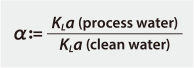
where KLa is the overall volumetric mass-transfer coefficient (also called the oxygen transfer coefficient), which indicates how quickly the oxygen dissolves into the water.
Taking α = 0.4 as an example, this means that the clean-water OTE will fall by 60%.
The alpha factor varies not only with the type of wastewater, but also with the type of diffuser. Of the many possible types, it is the alpha factor of porous air diffusers in sewage treatment plants that has been researched globally. Here we present three representative reports into such systems.
| Source | α factor |
|---|---|
| U.S. EPA Design Manual — Fine Pore Aeration Systems | 0.4–0.6 |
| U.S. Water Environment Federation Design Manuals | 0.45–0.65 |
| Evaluation of oxygen transfer efficiency and alpha-factor on a variety of diffused aeration systems (Groves et al., 1992) |
0.3–0.65 |
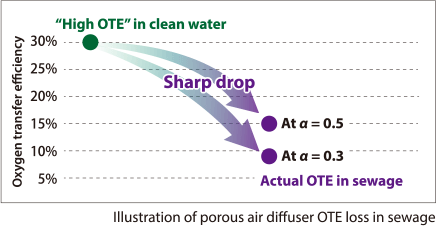
This data shows that, even in the relatively gentle conditions of sewage, where BOD and MLSS concentrations are considerably lower, OTE will be around 50% lower than in clean water. This means that, for example, a clean-water OTE of 30% will fall to around 15%, as illustrated at right.
Incidentally, the Singaporean sewerage authority indicated on their project specifications an alpha factor of 0.23 in the upstream area of the aeration tanks — that is, OTE can fall by as much as 77%, even in sewage. If the clean-water OTE was 30%, this would slash it to a mere 6.9%.
Case study: OHR vs rubber porous air diffusers at a sewage plant
In which the apparently “low-OTE” OHR AERATOR triumphs at identical airflow
Here we would like to introduce one of our real-world examples of sewage treatment.
Location:
(Small-scale sewage treatment plant)
Previous air diffusers:
OTE at 5 m water depth: 30% (as stated by the manufacturer)
Replaced every 18 months due to clogging
Upgrade:
Note that the OTE of the OHR AERATOR is approximately a third of that of the porous air diffuser.
Naively, one might expect that treatment would be impossible unless the air supply rate were tripled.
However, one full year of on-site operation demonstrated:
Zero observable change in treatment conditions, using the same blower as previously
Since the OHR AERATOR has vastly lower airflow resistance, this instead translates into energy savings
Diffusion of DO throughout the entire tank
This is proof of the power of the tank-churning water currents that the OHR AERATOR generates
All of this indicates that the OTE of the porous diffuser had dropped to a level comparable to that of the OHR AERATOR — in other words, that it had declined from 30% to 9.5%. This corresponds to an alpha factor of 0.32, which means that even in sewage, with its comparatively low BOD and MLSS, the OTE can fall by as much as 70%.
Industrial wastewater, on the other hand, features such an enormous variety of constituents across industries and products, and exhibits such extreme fluctuations in day-to-day load, that it does not readily lend itself to research. As such, there is a fundamental lack of reports into the value of α in industrial environments.
Despite this lack, seeing that contaminants are present at concentrations dozens of times higher and microbes present at concentrations several-to-several-dozen times higher than in sewage, it is apparent that the clean-water OTE will fall by 70–80% or more.
One major wastewater treatment company touts their porous diffusers’ OTE of 28% (at 5 m water depth), yet internally they conduct their calculations using a value of 7.5% — a steep drop of some 73% (28% → 7.5%). Work across numerous sites had led them to conclude that their clean-water OTE falls precipitously in wastewater, and they knew that oxygen deficiency issues would arise unless their calculations factored in the alpha factor of 0.27.
Even if you introduce “high-efficiency diffuser” designed for industrial wastewater treatment in the expectation of a high OTE on the order of 30–40%, an 80% drop will slash this down to 6–8%. In other words, values of 30–40% are little more than a kind of marketing “bait”.
End users are not informed of these facts, being left in the dark. This is how a great many sites, who were lured in by the marketing and ended up choosing these supposed “high OTE” air diffusers, are now faced with unexpected increases in power consumption and plagued by clogging issues that are intrinsic to all porous air diffusers.
For a more detailed look at clogging, please see our page 99% of air diffusers will clog.
What causes OTE to drop drastically in wastewater?
The myriad constituents that inhibit oxygen transfer
Wastewater contains a diverse array of pollutants: surfactants; fats, oils and grease (FOG); organic matter; and others. These are mixed in with the activated sludge (the large mass of microorganisms) in the aeration tank, and so additionally include a class of highly-adhesive, microbe-secreted macromolecules known as extracellular polymeric substances (EPS), and a type of surfactant known as biosurfactants.
These pollutants have a natural tendency to collect on the surface of bubbles and cover them in an instant, inhibiting oxygen transfer and thereby lowering OTE.
Please take a look at the following illustrations.
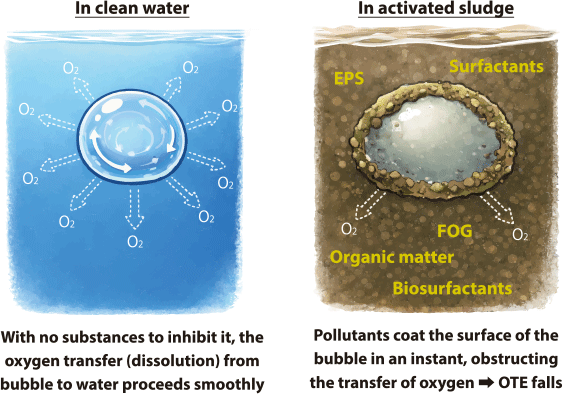
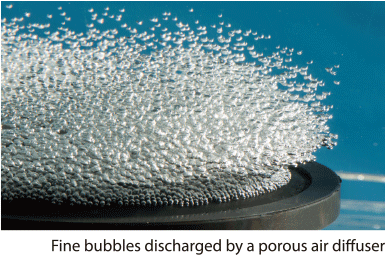
Porous air diffusers discharge fine bubbles with a diameter of a few millimeters. Smaller bubbles means a larger total surface area (gas–liquid interfacial area) with which to promote the transfer of oxygen from the gas phase to the liquid phase, and so the OTE appears to improve greatly in clean-water conditions. This has driven product development towards minimizing the size of the discharged bubbles.
However, the smaller the bubbles become and the more the interfacial area increases, the more susceptible they become to surface contamination; the upshot is that the gap in OTE between clean water and wastewater is liable to widen, leading to a significant reduction in the alpha factor of porous air diffusers.
Alpha factor of the OHR AERATOR: approximately 1.0
In other words, OTE in wastewater ≈ OTE in clean water
The OHR AERATOR’s alpha factor is approximately 1.0: there is little to no difference between clean water and actual wastewater.
The basis for this is twofold.
The OTE of the OHR AERATOR is by no means high, but it maintains this OTE in actual wastewater — whereas the OTE of porous diffusers plunges.
It is for this reason that, when compared in actual operating environments (wastewater), the OHR AERATOR shows greater OTE in many cases, and our track record is replete with examples of companies actually making energy savings.
Real-world examples
What is behind this unparalleled “α ≈ 1.0” performance?
Powerful gas–liquid collisions negate the effects of contaminants
The OHR AERATOR features specially-designed structures — patented in 12 countries across the world — that instantaneously break down wastewater and air into microparticles, then violently collide them.
Designed on fundamentally different technological principles from porous diffusers (which simply discharge fine bubbles), the OHR AERATOR affords contaminants no opportunity to coat the surface of the bubbles, so keeps the gas–liquid interface continually refreshed.
This is how it is able to achieve α ≈ 1.0.
Compared to rubber porous diffusers, the OHR AERATOR is able to generate more than 3.3 times the quantity of fine bubbles. Please watch the video below and appreciate visually how powerful its mixing ability really is.
OHR AERATOR mechanism